
Resources
Resources
The Power of High-Powered Lasers in National Security Applications
Jan 21, 2026. Blog
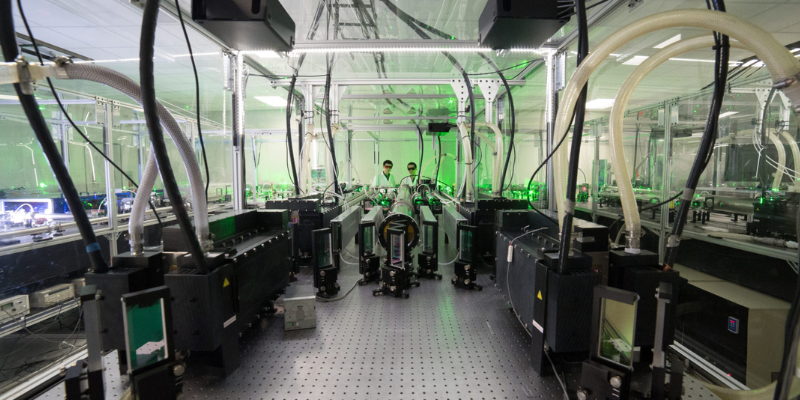
As national security challenges become increasingly complex, advanced technologies are stepping up to meet the demands of modern defense. Among these technologies, high-powered lasers are making waves, particularly in imaging and diagnostic applications. Recent advancements in laser-driven X-ray technology, such as those demonstrated at the Advanced Beam Laboratory at Colorado State University (CSU), are revolutionizing how we approach security and defense imaging.
A New Frontier in Imaging
One of the most exciting breakthroughs in laser technology comes from a research team at CSU, which has recently reached a landmark achievement in 3D imaging technology. For the first time, researchers successfully captured high-resolution computed tomography (CT) scans of large, dense objects using a compact, laser-driven X-ray source. This innovation paves the way for non-destructive testing of critical components such as gas turbine blades, rocket parts, and turbojet engines.
In collaboration with the Los Alamos National Laboratory (LANL) and Atomic Weapons Establishment (AWE) in the UK, the CSU team leveraged the ALEPH laser system, which produces extraordinarily bright X-ray sources. Reed Hollinger, CSU assistant professor and the study’s lead author, stated, “This demonstration is just the beginning. We aim to ramp this into something that can make a broad impact.” He added, “Using this laser-driven X-ray source, we’re pushing the limits of what is possible in high-resolution x-ray tomography of very dense objects. This will open up a world of possibilities that could enable better inspection and qualification of complex 3D-printed metallic parts in areas such as aerospace and power generation.” This technology has implications for advanced manufacturing, ranging from aerospace to cutting-edge 3D printing for rapid prototyping and custom component fabrication. It holds significant promise for national security applications, where precision and reliability are paramount.
Why High-Powered Lasers?
High-powered lasers are revolutionizing X-ray imaging, particularly in national security applications. Traditional high-energy linear accelerators (LINACs) X-ray sources offer millimeter-scale resolutions, which can limit their effectiveness in detecting and analyzing complex structures. In contrast, laser-driven sources generate microfocused, high-energy X-ray beams that can penetrate dense materials more effectively with higher resolution. Most conventional X-ray machines, such as those used in medical imaging and security settings like airport scanners, typically operate within the tens to hundreds of kilovolts (kVp) range, commonly around 100 to 200 kVp. This voltage influences the energy of the emitted x-rays, directly affecting their penetration capability. These x-rays are too low in energy to penetrate dense objects such as thick 3D-printed metallic structures.
The unique phenomena associated with high-power laser plasma interactions yield compact MeV X-ray sources that emit for trillionths of a second. This technology is crucial for capturing dynamic objects, such as engines in operation, enabling the visualization of dense, rapidly moving targets that existing X-ray technologies struggle to image. As we delve into the implications of these advancements, it becomes evident that high-powered lasers are poised to redefine detection methodologies in critical fields, particularly in national security.
Implications for National Security
Using high-powered lasers in imaging has obvious implications for national security applications, particularly in defense technology monitoring and testing. Here are several key areas where these advancements can have a profound impact:
- Non-Destructive Testing of Military Assets. It is invaluable to inspect critical military components meticulously without damaging them. Whether for rocket components or aircraft engines, high-powered laser-driven X-ray imaging allows for rapid and precise evaluations that enhance effectiveness and safety.
- Quality Control in Defense Manufacturing. Like the energy sector, the aerospace and military industries are increasingly adopting additive manufacturing. Advanced laser-driven imaging techniques that provide high-resolution insights into internal architectures can help ensure the integrity of complex structures produced through such methods as additive manufacturing.
- Flash Radiography for Dynamic Events. The ultrafast nature of laser-driven x-rays enables time-resolved imaging of high-speed subjects, like projectiles or explosive tests, with minimal motion blur. This capability enhances our ability to understand and assess the dynamics of these high-stakes events in real time.
Looking Ahead
The research conducted at facilities like CSU's Advanced Beam Laboratory underscores a broader vision for harnessing high-intensity laser sources to address national security challenges. The capabilities being developed may eventually allow for applications ranging from inertial fusion energy research to producing bright beams of high-energy x-rays and electrons.
The Advanced Technology Lasers for Applications and Science (ATLAS) facility, which is expected to open in 2027, will further enhance CSU's laser and experimental capabilities, leading to even more robust applications in security and defense.
Conclusion
High-powered lasers are rapidly becoming essential tools for national security, particularly in imaging and diagnostics. The breakthroughs achieved by teams at facilities like CSU's Advanced Beam Laboratory are impressive in their technical merits, and they promise to transform how we approach critical defense applications.
As this technology continues to evolve, its potential benefits—from improved quality control in defense manufacturing to the ability to visualize critical components with unprecedented clarity—could play a vital role in ensuring national security in an ever-changing global landscape. The future is bright, and with high-powered lasers at the forefront, we are set to navigate the complexities of national security more effectively than ever before.
Join us at LaserNetUS to stay abreast of the latest advances in high-powered lasers.
More From Blog